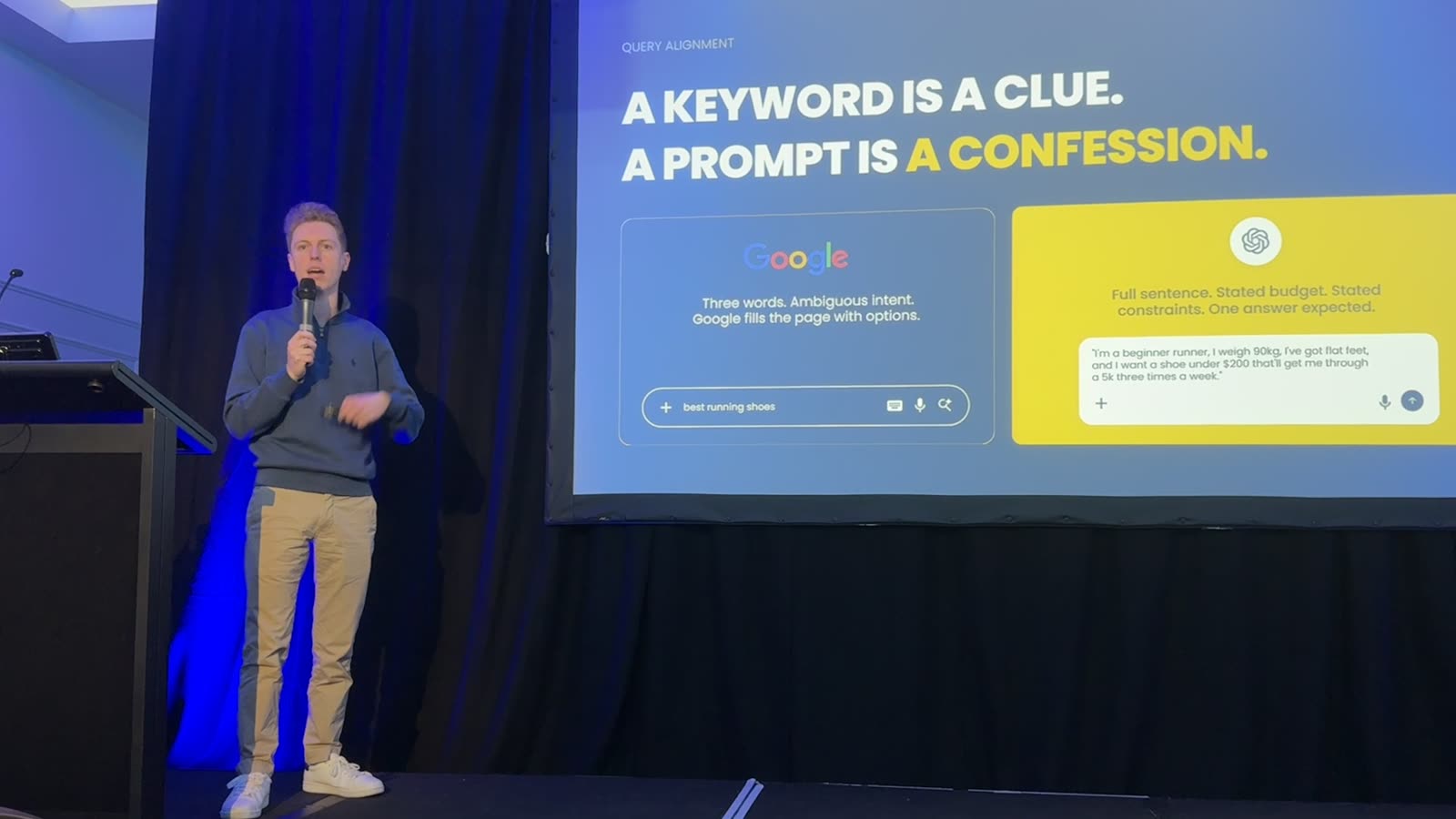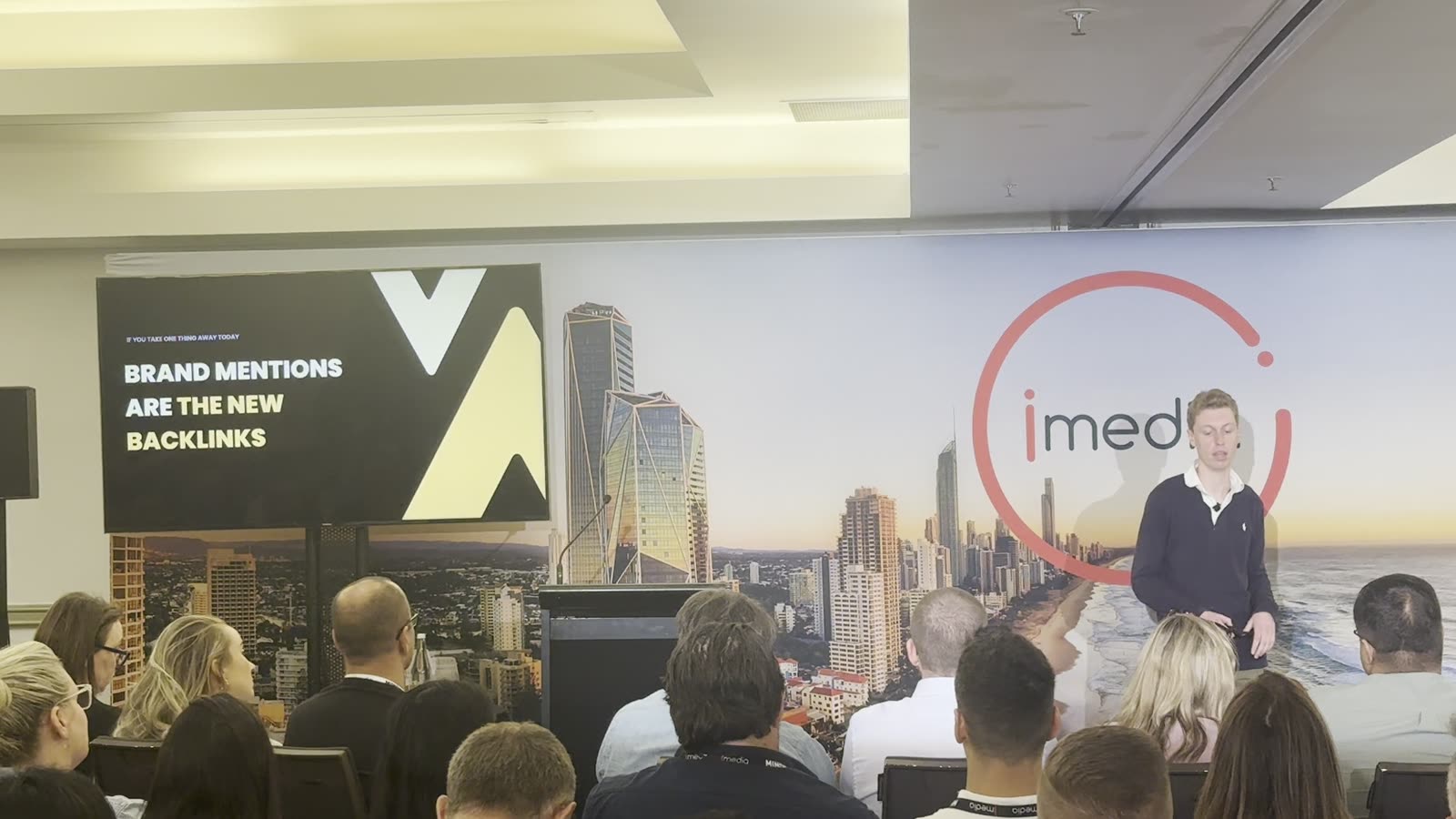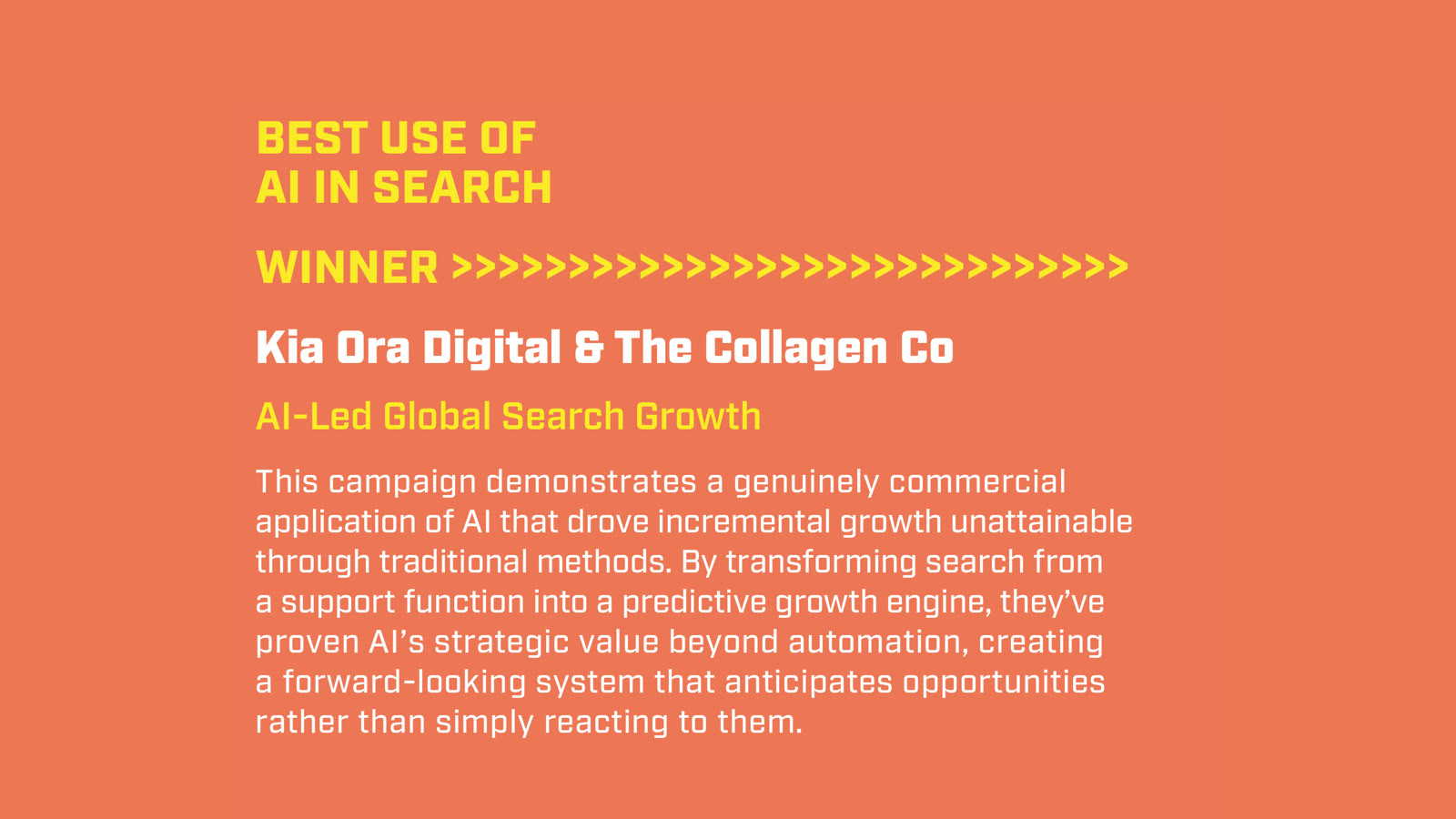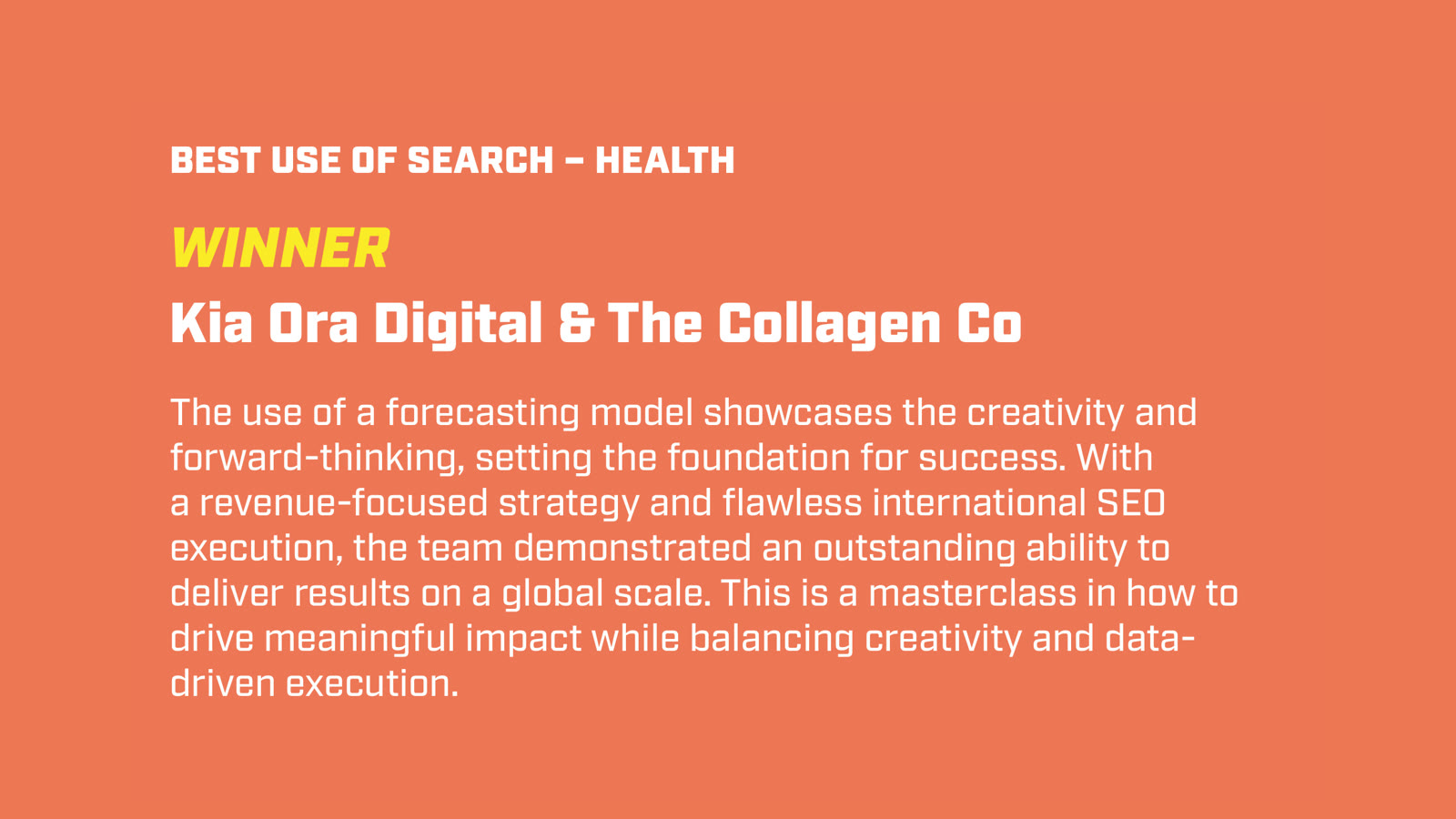
Ben McIntyre at iMedia in Queenstown on 14 May 2024, on the problem that keeps SEO out of the budget: nobody can tell you what it is worth before you spend it.
The answer he demonstrates on stage is a forecast built from click-through rate by position, a site's own analytics, and per-keyword commercial data, then run live on a single keyword to show what moving from position seven to position one is worth in dollars. It is the thinking behind the revenue forecasting work.
A note on the date. This talk predates the AI search material by nearly two years, and it is deliberately about Google. For where the same team's thinking went next, see the Think Water talk and the iMedia 2026 talk.
The short version
- SEO gets sidelined because paid media reports an ROI on Monday and SEO says "give it twelve months". That is a measurement problem, not a channel problem.
- Click-through rate collapses after position one. In ecommerce, position one takes 28.5% and position two takes 10.2%.
- Page two is effectively dead. Only 6% of searchers get there, and under 2% go past it.
- Combine CTR curves with a page's own conversion rate and average order value and you can put a dollar figure on a single keyword, at its current position and at every position above it.
- The commercial goal is not just more organic revenue. It is reducing what the business has to spend on ads to stand still.
Why SEO gets left to one side
Ben's framing of the industry problem, from having built the agency around it.
Merchants struggle to see what organic search is actually returning. The data is hard to read, so it is unclear where effort should go. There is often no deep technical SEO knowledge in the business, so the channel gets parked. And paid search reports an immediate, attributable ROAS, which makes it the safe place to put money.
The result is a channel that gets judged as "we are not sure what we are getting, so we will not touch it".
The numbers that make position one non-negotiable
Organic is the starting line: around 8.5 billion Google searches a day, and 93% of online experiences beginning at a search engine. People start on search and move outward from there.
Then the drop-off. You are more than ten times more likely to be clicked at position one than at position ten, and both of those are on page one. Only 6% of users ever reach page two, and fewer than 2% go beyond it.
The click-through curve makes it sharper. In ecommerce and shopping, position one averages 28.5%. Position two averages 10.2%. By positions six, seven and eight you are working with very little. Almost the entire value of page one sits in the top three.
The paid media squeeze
The second half of the commercial argument.
The cost of Google Ads keeps rising while returns keep falling, which compresses profitability. So the goal is not organic growth on its own. It is organic growth that lets a business reduce what it has to spend on paid to hold the same position, which is what actually moves profit.
What if you could model revenue from keyword movement?
The core idea: instead of a twelve-month strategy that asks for patience, run short sprints with one outcome, organic revenue, and know the value of the target before starting.
The forecast combines the CTR-by-position curve with data pulled from the site's CMS, Google Analytics and Search Console, then layers on per-keyword and per-page metrics: search volume, current position, keyword difficulty, click-through rate, average order value and the conversion rate of each individual page. Broken down page by page and keyword by keyword.
That gives you the real organic revenue a keyword is producing now, and a model of what it produces at every position above.
The suitcase demo
The part worth watching rather than reading. Real data, undisclosed business.
The keyword is suitcase, at 25,000 searches a month. The business sits at position seven, earning just over $4,500 a month from that one keyword.
Moving up one position adds a little. Moving to position one takes it to just under $40,000 a month. From one keyword.
Now scale that to a large retailer with thousands of commercial keywords sitting at positions two to five, and the exercise stops being about traffic. It becomes a list of moves ordered by what each one is worth.
Where this points the strategy
The output is a focus list. Instead of chasing everything that might produce some traffic, you build topical authority around the specific keywords that carry commercial value, because dominating those is where the return is.
The takeaways Ben closed on:
- You can now quantify the potential ROI of SEO on non-branded keywords.
- Technology can point the work at the hidden revenue rather than the volume.
- As organic revenue rises, paid media spend can come down, which lifts overall profitability.
Questions from the room
How does generative AI change this? The service-side content play, the how-to article, is the part most exposed to AI-generated answers. Product-led ecommerce search is different: people are still searching for specific products, and that is where the revenue-generating keywords sit. The honest answer given was that it is changing every channel and needs constant iteration.
What about competing against Wikipedia-scale domains? Very hard to outrank on authority. But a searcher who lands on a page that cannot sell them anything bounces and keeps going until they find one that can. The competition that matters is the other ecommerce sites on that result, and the first of those takes most of it.
How accurate are the forecasts? Answered straight: still in beta at that point, about twelve months of tracking, with strong movement observed when a strategy targeted a specific product category. Data on accuracy rates was still being collected.
Full transcript
Transcribed with Whisper large-v3-turbo from the source recording and lightly cleaned. Filler and false starts are trimmed, wording is otherwise unchanged. Audience questions were captured off-microphone and are partly indistinct; corrections are listed at the end.
Why we started the agency [00:00]
[00:00] So one of the things that we noticed when we started the agency was that there are a lot of digital marketing agencies around who are full service. They offer a whole suite of services, and often SEO is one of those kind of technical services that doesn't always get the time of day, or as much time against it as it potentially should. And it's quite a lucrative revenue stream if you get it right.
[00:30] So essentially we've now got about 120 what I like to call whānau members, or family members, in our client base. A lot of these are now Australian-based businesses, so we've started to expand globally. We're looking at launching in the UK later this year, and we've been seeing some really substantial growth, which has been quite phenomenal.
[00:56] One of the key things is we've got a really heavy focus on innovation and technology solutions, and that includes a little bit of AI, and that's what I'm going to talk about today. It's primarily some of the technology advancements that we've been building and working on. And obviously SEO is one of these quite technical channels, so there's a bit to kind of get into.
From software development to SEO [01:18]
[01:18] So just to give you a little bit of insight as well, my background was originally in software development. So I came out of the software industry, built a lot of custom software solutions for businesses. And one of the things I saw is people would invest a huge amount of money into their custom websites and custom software tools, and not actually end up getting a lot of traffic to those tools or to those platforms, because they weren't setting them up properly from an organic perspective.
[01:52] So that is what really got me intrigued in the SEO space, and that's how we come to form this agency.
Why SEO gets left to one side [02:01]
[02:01] So I just want to start off a little bit with some common SEO industry pain points, or misconceptions. Often SEO is considered this mysterious dark art, and one of the key issues that we often find is that merchants especially have difficulty understanding the true ROI that organic search is producing. Often data is really hard to understand, and they're unsure where their focus should be.
[02:29] So the other thing is there tends to be a general lack of technical and general knowledge around SEO, and this is often due to lack of experience or expertise in the space, and therefore it can be left to kind of one side and not necessarily looked at as much as it should be.
[02:47] What also tends to happen is that organic search gets overshadowed a little bit by paid search and other paid marketing channels. And those channels obviously return an immediate ROI and ROAS. It's really easy to track. And so therefore SEO is seen as, we're not too sure what we're getting, therefore we're not going to touch it, because we know what works.
Three questions we started with [03:04]
[03:04] So we asked three key questions when we started out. One, how do we make our approach different? How do we do things a little bit differently compared to the others? How can we be unique?
[03:20] How can we demystify the process a little bit? How can we provide more clarity to businesses so that they can actually understand the true potential that organic search has for them, and show some insights and some data that maybe others haven't been able to produce in the past?
[03:36] And also, how do we uncover real value using data and technology? How do we be completely different and really get into the data aspects, the data elements of SEO, and provide some further insights from that perspective?
How big organic actually is [03:49]
[03:49] So just to give some insight on the SEO industry and organic search. It's 8.5 billion Google searches per day. It's a massive channel, that's globally. 93% of all online experiences start with a search engine.
[04:05] So that means that people are starting their journey on search and then they might be migrating to other platforms via social channels, but Google and search engines in general are a massive starting point and a massive space to be in.
Position one versus everything else [04:23]
[04:23] You're 10 times, or over 10 times more likely to be clicked in position one than you are in position 10, even on page one. So that really signifies how important it is to be higher up the page as opposed to further down.
[04:41] And also, just 6% of users actually get through to page two. So there's very few users that actually get beyond that first page and page two, and then less than 2% go beyond that second page. So again, really, really important to ensure that you are ranking in one of the top spots on the first page.
Unlocking hidden revenue [05:16]
[05:16] So when we set out, we had a mission to begin with. We wanted to find ways of unlocking hidden revenue streams using advanced data insights and AI. Our thinking was that if we broke down the challenges around understanding the data, and made it really clear to merchants where opportunities lie, then we would make it really clear where the investment should lie.
Sprints, not year-long strategies [05:53]
[05:41] So we've seen many businesses undergo long-winded SEO strategies over time. Strategies that go on for years and years and years. You get these things where you say, "hey, it's going to take 12 months before we even see anything," and that's a real difficulty.
[05:53] So what we wanted to do is provide a strategy that is fast and quick and sprint-orientated, that is confined to a set period of time, that is really targeted with one pure outcome. And that pure outcome is organic revenue growth.
The paid media squeeze [06:18]
[06:10] And the other thing that we wanted to do is ensure that we actually get to a point where we can reduce reliance on paid media spend. Because at the end of the day, as we know, paid media spend is increasing.
[06:18] The amount of money you're having to invest into things like Google Ads is going up, and unfortunately the returns are going down, which impacts ultimately our profitability and the returns that you're getting.
[06:30] So the third thing for us was to be reducing reliance on paid media to improve businesses' overall profitability.
What if we could model revenue? [07:01]
[06:52] So how do we do this? We did a lot of thinking, we had a lot of discussions, a lot of R&D, and after quite a bit of research and a lot of different ways of doing things, we come up with this concept around organic traffic revenue forecasting.
[07:01] So we said to ourselves, what if we could model revenue outcomes based on keyword movements? What would happen if we could say to a business, this is the potential revenue you could be generating based on these movements organically?
[07:20] So what we did was we built a tool called an organic revenue forecast, or an organic traffic and revenue forecast. So what this does is combine a whole lot of data models together, and it produces something that's quite interesting for merchants to understand.
[07:39] So I just want to open it up to everyone here to think, just in the business that you work in, whether you're e-commerce or a solution provider, think of one relevant non-branded, so everything that we're talking about here is completely non-branded, which means a keyword that doesn't include your business name.
[07:58] Just think of a non-branded keyword that your business should rank for, or might rank for. Just keep it in the back of your head, because we're kind of coming back to this a little bit later. But something that you would expect, if you were to put into Google a random keyword that relates to your business, product or service, what might that be?
Click-through rate by position [08:21]
[08:21] So what I'm going to show you here is something that's really interesting. So this is the ranking position versus the click-through rate.
[08:29] So what we can see at the very beginning of the graph is position number one gets an average click-through rate of 28.5%. So that's quite significant. So what that essentially tells us is that every time you put a search into Google, the top spot is likely to get a click-through rate of roughly 28.5%. At least a quarter of searches or users are going to click on that first spot.
[08:58] But what's really, really interesting is that the second spot decreases quite significantly. It goes down to 10.2%. And this is on average for e-commerce and shopping industry. This data comes from an external data source. There's a whole load of research around click-through rates, and you can look at it by every different industry. Different industries have different click-through rates.
[09:28] So you can see here that the graph trends down quite substantially, and when you get beyond position five and into six, seven and eight, you're dealing with quite low click-through rates. So again, it just signifies the importance of how valuable it is to actually take one of those top three spots, especially the top spot. So it's a huge traffic generator.
How the forecast is built [09:50]
[09:50] So how do we actually use this data to forecast organic revenue? So one of the things that we look at is the click-through rate data that we just looked at on the previous slide, and the amount of clicks that you're likely to receive based on the positioning that you sit.
[10:12] We also pull in a whole lot of external business data. So we pull in all of this data from the existing CMS web platform. We also pull in data from Google Analytics, Google Search Console, a whole lot of data collection points.
[10:31] And we combine this historical business data with a whole lot of key metrics, such as search volume, current positioning of where those keywords sit, keyword difficulty, click-through rates, average order value, and conversion rate of each individual page. We'll break this down across every page of a website, and we look at it at an individual keyword level.
[10:57] And what we're able to do, when we combine this data, is use some advanced data modelling to determine what the true organic traffic and revenue is that a business is generating on a particular keyword. And then using the industry data, we're able to then forecast and predict what the potential revenue outcomes might look like as those positions increase or decrease within Google. So as you go up and down, we can predict what sort of revenue you're likely to generate.
Live demo: the keyword "suitcase" [11:34]
[11:34] So how does this look? Here is a demo of what this tool actually looks like.
[11:38] And so I've just got a completely random keyword here, suitcase, undisclosed business. This is actually true data for an actual business coming from an actual website.
[11:52] So this particular business sits right now position number seven for the keyword suitcase. Suitcase receives 25,000 searches a month in Google, so a reasonably high-volume keyword. And what we can see here is at the moment the business is generating just over $4,500 a month specifically from that keyword.
[12:20] So what happens if that keyword moves one position? That revenue increases just a little bit, it's not a huge amount. But as you can see, as those positions increase from position seven, six, five, four, three, two, one, you can end up getting to quite an extraordinary revenue level of just under $40,000 specifically on that one keyword.
[12:52] So if you think of big merchants that have huge numbers of keywords generating millions of dollars organically, if you're able to figure this out and go through every high-value keyword and look at the opportunities to improve those keywords just by one or two spots, if they're sitting currently position five, four, three or two, then there's quite substantial revenue to be generated specifically from those movements.
[13:28] So I just want you to now think about that non-branded keyword that I asked you to think about before, and think about it in your business terms. How insightful would it be for you to know, one, where does that keyword currently sit in Google? And you could have a look, open it up, search in Google.
[13:52] How valuable would it be for you to know what the current organic revenue is that that keyword is generating based on where it sits right now? If it's number one, that's fantastic. You've also got to be mindful that that could potentially go up and down. So you've got to be at the top of your game to ensure that you remain position one.
[14:14] And also, how useful would that then be if you could understand what the potential organic revenue could be should that keyword increase, if it's not already in that top spot right now?
Topical authority and where to focus [14:29]
[14:29] And so what this does for us is, by using a tool like this, it gives us a direct data-driven approach to exactly where our focus is when it comes to undergoing or executing an SEO strategy. Instead of focusing on all of these kind of things that maybe don't necessarily matter, or might generate a little bit of traffic, what we're wanting to do is build topical authority. We're wanting to build specific focus around particular keywords that have high value to the business. Because if the business can dominate on those particular keywords, the ROI and the return is going to be substantial.
Key takeaways [14:50]
[14:50] So just some key takeaways. We can now quantify the potential ROI on SEO for non-branded keywords, which is quite unique and not something that many have been able to figure out before.
[15:05] We can now deploy specialist technology into the way that we go about SEO, and use tools to unlock these hidden revenue opportunities in a precise and very targeted way.
[15:19] As your revenue increases, we also can now look to reduce reliance on paid media spend, which ultimately is the ideal outcome for us. We're trying to assist businesses to reduce their paid media spend and at the same time generate more revenue, increasing their overall profitability.
[15:39] So that's all that I've got to share today. I'm happy to open up quickly. I've got a few more minutes if anyone wants to ask any questions.
Questions from the room [15:48]
[15:48] Question: How do you see SEO strategy changing with generative AI moving into search?
[15:55] Ben: Yeah, so definitely that space is going to change quite substantially over time. I think about e-commerce though. A lot of what we're doing is purely around product-based searches, or e-commerce in the e-commerce space.
[16:12] So you've got to think about a lot of the historical service-based businesses who would write content around how to do specific things. That's now being replaced by generative AI, in the way that those AI tools are producing content.
[16:30] But for now, we're going to still have an industry where people are searching for particular products, and that's where these revenue-generating keywords are really, really important. So the AI space is definitely changing the way that every marketing channel is working. But it's just something that we want to be continually iterating on and ensuring that we're on top of.
[17:14] Question: (Indistinct, off-microphone. The question is about competing for a product term where a large authoritative site such as Wikipedia ranks.)
[17:20] Ben: So when you're against the large, really strong authoritative domains, it's really, really hard to get ahead of those. Getting ahead of those is difficult.
[17:40] The one thing to note, though, is if we are trying to attract a buyer, and they end up on, let's say, Wikipedia, they're less likely, obviously Wikipedia is not going to be a place where they're able to actually purchase the product. So therefore the likelihood for that particular keyword is that people will then bounce out, and they'll miss that one and then go further down until they find the site that actually sells the product.
[18:05] But if you're thinking about where you sit against your competitors, if there are three sites that are all ranking, that are all e-commerce sites selling some other product or service, then the likelihood of them going to that first one and then not going beyond that is quite high.
[18:34] Question: I'm assuming you've been tracking how accurate the predictions were as well. What's the kind of range, up and down?
[18:40] Ben: Yeah, that's right. So we're reasonably early on in a lot of this tech and we're continually making iterations. So we're still kind of in a beta phase, where we've been running these tools now for about 12 months and we've been tracking that revenue.
[18:58] What's been quite interesting is that we have been seeing really substantial increases in specific areas. What we do is we focus on a particular product range or area for an e-commerce merchant, and then track that revenue specifically around that category of product, or type of product, across the months following executing a strategy specifically on those. And we've been seeing really significant movement in organic revenue as those positions have been increasing.
[19:28] So we're still collating quite a bit of data around just exactly what the success rates might look like, but it's been really promising with what we've seen to date. And what we know is that we're focusing on the things that do drive revenue.
Close [19:40]
[19:40] Very good. Well, thanks for listening. I did have my little QR code up there before, so if you want to discuss any of what I've talked about today, feel free to come and see me at the event. Thank you.
(End of recording, 19:56.)
Transcription notes
Produced locally with Whisper large-v3-turbo, forced to English, from the source recording. Audience questions were asked off-microphone and are the weakest part of the audio.
| Timestamp | Whisper heard | Corrected to | Confidence |
|---|---|---|---|
| 04:23 | "more likely to be flipped in position one" | clicked in position one | High |
| 10:39 | "keyword difficultiness" | keyword difficulty | High |
| 18:34 | "how anti-reviewed predictions were" | how accurate the predictions were | Moderate, reconstructed from Ben's answer |
| 17:14 | "I feel like you've worked in UBD, in me, in Wikipedia" | indistinct | Low, the question is not recoverable from the audio and has been summarised |
| 17:33 | "the bookopedias of the world" | authoritative domains | Moderate, garbled |
| 18:05 | "all e-commerce marketing selling are some other product" | all e-commerce sites selling some other product | Moderate |
| 00:30 | "whanau" | whānau | Spelling only |
The 8.5 billion searches a day and 93% of online experiences figures are widely-cited industry numbers, not Kia Ora Digital research. The click-through rate curve is attributed on stage to an external dataset for the ecommerce and shopping category. Source them properly before reusing any of the three in client material.